 Let me guess. Your inbox is drowning in goal-setting workshops right now.
“10X Your Production!” “Crush Your Goals!” “Hit Your Biggest Year Ever!”
Yeah, mine too. And honestly? I’m exhausted just reading those subject lines.
Here’s the thing. After 36 years of helping real estate agents build sustainable businesses, I’ve noticed a pattern. The agents who hit their goals? They’re often stressed and burned out. The agents who miss their goals? They feel like failures. Either way, they’re exhausted.
Something was broken.
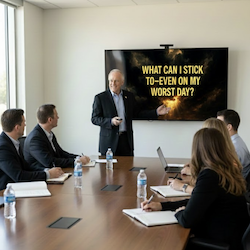
So I created The Un-Goal Setting Workshop. Not to teach agents to set better goals, but to challenge the entire framework of goal-setting itself. I ran the first one last week, and what happened validated everything I’ve been thinking about agent burnout for years.
Before I discuss the workshop, let me explain why it exists.
The Problem Nobody Wants to Say Out Loud
Traditional goal-setting asks you to commit to specific numbers. Deals closed, GCI earned, volume produced. in an environment where you control almost nothing.
Think about it. What can you actually control in real estate?
You can’t control:
- Interest rates (try as you might)
- Housing inventory (or lack thereof)
- Buyer/seller motivation (people are weird)
- Economic conditions (thanks, Federal Reserve)
- Seasonal market fluctuations (winter slowdowns are real)
- Your competition (there’s always another agent)
Yet every January, we set goals based on outcomes we can’t control. Then we spend the year stressed about whether we’ll hit them. By March, most agents feel behind. By December, they’re either burned out from overwork or demoralized from “failing.”
The cycle is broken. And we keep repeating it.
What You CAN Control
Here’s what I’ve learned. Your success isn’t built on perfect days. It’s built on showing up consistently, especially on the worst days.
Instead of asking, “What do I want to achieve this year?” I started asking a different question:
“What can I stick to. Even on my worst day?” Not your best day when you’re crushing it, and motivation is sky-high. Your WORST day. When a deal falls apart at 4:55 pm on Friday. When you’re running on four hours of sleep. When you’re questioning if you even belong in this business.
What can you STILL do?
This question became the foundation of the entire workshop.
Because here’s what you CAN control:
- Your daily actions (show up or don’t. That’s on you)
- Your systems and processes (build ’em or wing it)
- How you respond to challenges (victim or victor?)
- Your learning and growth (invest in yourself or stay stagnant)
- The relationships you build (quality over quantity, always)
See the difference? One list makes you powerless. The other puts you in the driver’s seat.
The Six Sessions: Building Sustainable Systems
The workshop included six core sessions, and I’ll provide a high-level overview of each.
Session 1: Why “No Goals” Might Actually Be Your Best Strategy
We started by examining why traditional goal-setting creates chronic stress instead of sustainable success. I walked agents through the Goals vs. Systems framework – goals focus on outcomes you can’t fully control, while systems focus on processes you CAN control.
We did a “Goal Fatigue Inventory” where agents rated statements like “I feel guilty when I don’t hit my goals” and “I set goals and then forget about them within weeks.” Most agents scored in the “high” or “severe” goal fatigue range. That’s not a personal failing – it’s a broken system.
The key insight? If you’re constantly setting goals and not hitting them, you’re not broken. The framework is.
Session 2: The Business Audit – What’s Actually Working vs. What’s Just Keeping You Busy
This is where we got brutally honest. Agents mapped their current activities on a grid with two factors: time/energy consumed and business generated.
Four quadrants emerged:
- Upper Left: High results, low effort (your goldmine – do MORE of these)
- Upper Right: High results, high effort (optimize or delegate these)
- Lower Left: Low results, low effort (delegate these entirely)
- Lower Right: High effort, low results (the drain zone – STOP doing these or delegate them)
The revelation came when agents realized they were spending 60% of their time on activities that generate 10% of their results. We also tackled the “should” list – all the things agents do because someone told them successful agents do it, even when it’s not working for them.
Permission granted: You don’t have to do it all.
Session 3: Designing Your Ideal Business Day
Here’s where we stopped fighting natural rhythms and started working with them. Agents mapped their energy levels throughout a typical day, then matched high-energy activities (prospecting, negotiations) to high-energy times, and low-energy activities (admin, research) to low-energy times.
We also tackled boundaries. Real estate agents are notorious for having zero boundaries – answering calls at 9pm, showing houses on Christmas Eve, letting clients dictate their entire schedule. But here’s the truth: the clients who don’t respect your boundaries usually aren’t your best clients anyway.
The goal wasn’t to design the “perfect” day – it was to design YOUR ideal day based on your actual energy patterns and life circumstances.
Session 4: Building Sustainable Systems (That Actually Work)
This was the core of the workshop. We built four systems that every real estate business needs:
- Lead Generation – Consistent activities for creating opportunities (daily, weekly, monthly)
- Follow-Up – Staying connected with new leads, active prospects, past clients, and sphere
- Client Experience – Your process from contract to close and beyond
- Personal Development – How you stay sharp and avoid burnout
But here’s the critical filter for every system: Can you stick to it even on your worst day?
If a system requires perfect conditions, high motivation, tons of energy, or everything going right – it WILL fail. Your systems must be worst-day proof. Period.
Session 5: Adaptive Routines for Changing Markets
Markets change. Life happens. You need protocols for when things shift.
This session introduced the “Minimum Viable Week” – the three non-negotiable activities you’ll do no matter what. Not seven. Not ten. Three.
These became your lifeline when everything’s falling apart, when you want to hide under the covers, when motivation is at absolute zero. If you do nothing else, do these three things.
We also built pivot protocols for different scenarios: inventory drops, interest rate spikes, competition intensifies, or you hit a personal rough patch. Because the question isn’t IF markets will change – it’s WHEN and how you’ll respond.
Session 6: Reframing Success (Beyond the Numbers)
The final session challenged agents to define success without mentioning deals closed, commissions earned, or dollar amounts.
What does success look like when you remove transactions from the equation?
We identified 5-7 success indicators that actually matter – things like consistent daily activity, quality of client relationships, energy levels at end of workday, work-life balance maintained, skills developed. Then we built a 90-day experiment to track systems and habits instead of outcomes.
The shift is subtle but profound: Instead of asking “Did I hit my goal?” you ask “Did I show up for my systems?”What This Actually Means for You
You might be reading this thinking, “Okay, Jerry, so no goals. Then what?”
Here’s what. you build systems you can control. You focus on daily actions instead of distant targets. You create sustainability instead of intensity.
Look, I’m not saying outcomes don’t matter. Of course they do. But outcomes are a lagging indicator. they show you what already happened. Systems are a leading indicator. they show you what WILL happen if you stay consistent.
And here’s the thing about systems. They work whether you’re motivated or not. They work when the market shifts. They work on your worst days.
Goals depend on external factors playing nice. Systems depend only on you showing up.
The Honest Truth
If you’re coming to this thinking I’ll tell you how to close 50 deals next year, you’re going to be disappointed.
But if you’re tired of the hamster wheel, exhausted from goal-setting that doesn’t work, and ready to build something sustainable, this framework might change everything.
Because your success isn’t built on perfect days, it’s built on showing up consistently. especially on the worst days.
So here’s my question for you.
What can you stick to, even on your worst day?
Not “What should you do?” Not “What do top producers do?”
What can YOU do when a deal falls apart, when you’re exhausted, when life gets chaotic, when you’re discouraged, when everything feels hard?
Start there. Build your systems around that. Make it worst-day proof.
And watch what happens when you focus on what you can control instead of stressing about what you can’t.
If you’re interested in learning more about this approach or want to know when I’m running the next workshop, reach out. But honestly? The most important thing is that you start asking yourself that central question. and building systems around your answer.
Up your game. Finish strong.
Discover more from RealtyTechBytes.com by Jerry Kidd
Subscribe to get the latest posts sent to your email.