 Let me say what everyone’s thinking: blogging is dead. Nobody reads blogs anymore.
And you know what? You’re right. Sort of.
I mean, when’s the last time you woke up thinking, “You know what sounds great today? Reading a real estate agent’s blog!” Probably never. Your clients aren’t doing it either. They’re scrolling Instagram. They’re watching TikTok. They’re asking ChatGPT their questions instead of searching Google.
So yeah, if you’re thinking “blogging” the way we thought about it in 2007 when I started RealtyTechBytes—people subscribing via RSS feeds, checking your site daily for updates, leaving thoughtful comments—that’s absolutely dead. Gone. Not coming back.
But here’s what isn’t dead: Google searches. Social media posts. Email newsletters. Video scripts. LinkedIn articles. Client trust. Market authority.
Every single one of those things needs CONTENT. Real content. Your content. Content that only YOU can create because you know YOUR market, YOUR clients, and YOUR expertise.
And that content has to come from somewhere.
The Shift Nobody Wants to Talk About
Here’s what changed between 2007 and 2025: People stopped visiting blogs, but they never stopped needing answers.
Think about this: Your buyer still Googles “should I wait until spring to buy a house in Danville.” Your seller still searches “how to price my home in a shifting market.” Your sphere still wonders “is now a good time to sell?”
The questions didn’t disappear. The consumption pattern changed.
In 2007, they’d find your blog post and read it on your website. In 2025, they find that same content through Google, see it quoted on your LinkedIn post, get it in your newsletter, watch you explain it on a Reel, or—here’s the kicker—an AI tool pulls from it to answer their question.
But here’s the mistake most agents made: When they heard “blogging is dead,” they stopped creating long-form content entirely. They gave up their content engine. And now? Now they’re scrambling every single day asking “What should I post on social media?”
They’re stuck in the content hamster wheel, and they can’t figure out why they’re exhausted.
Your Blog Isn’t the Destination. It’s the Engine.
Let me reframe this for you: You’re not writing blog posts for people to read on your blog anymore. You’re creating the SOURCE MATERIAL that powers everything else in your marketing.
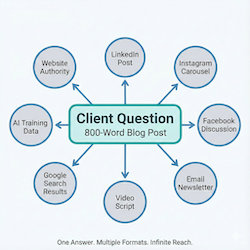
Your “blog post” is the engine. The hub. The mother ship. It’s where you write the answer ONCE, thoroughly and completely, and then you repurpose it into every format your audience actually consumes.
One piece of content. Multiple formats. Infinite reach.
This isn’t theory for me. I’ve written over 1,700 articles since 2007. I still publish weekly. And I’m telling you—the system works better now than it ever did, because now I know the blog post isn’t the end product. It’s the beginning.
The System: From Client Question to Content Engine
Alright, here’s how this actually works. Not in theory. In practice.
STEP 1: Capture the Question
A client asks you something. Could be in person, on a call, via text, in a showing. Doesn’t matter.
“Should I wait until spring to list my house?”
“How do I know if I’m getting a good deal in this market?”
“What’s really happening with interest rates?”
“Is it true that AI is going to replace real estate agents?”
That’s not just a question. That’s content gold. That’s a blog post. That’s your social content for the next week. That’s your newsletter topic. That’s your LinkedIn article.
But most agents answer it verbally, feel good about helping their client, and then… nothing. The expertise evaporates into thin air.
Stop doing that.
Start keeping a running list. I use Apple Notes. You might use a voice memo app (baby boomers, I’m looking at you—this is perfect for you). You might use a Google Doc. Whatever. Just capture the question immediately.
STEP 2: Write the Long-Form Answer ONCE
Here’s where you sit down and actually write out your answer. Thoroughly. Completely. Like you’re explaining it to someone who genuinely wants to understand.
Aim for 600-1,000 words. I know that sounds like a lot, but you can talk for 10 minutes about this topic, right? That’s 600-800 words when transcribed. You already know this stuff.
Here’s the format I use:
- Start with the question (exactly as asked, or close to it)
- Give context (what’s happening in YOUR market right now)
- Provide your expert answer (with specifics, data, examples)
- Include the nuance (the “it depends” factors)
- End with action steps (what should they actually do)
Now, you can write this from scratch. Or—and here’s where I lean into the AI tools I teach—you can use ChatGPT or Claude to help you draft it.
I’ll record a voice memo explaining my answer (2-3 minutes), use a transcription tool like Otter.ai or the built-in transcription in most phones, clean it up, then feed it to ChatGPT with a prompt like: “Turn this into a 800-word blog post for real estate agents in [your market]. Keep my voice and expertise, but structure it clearly.”
The AI drafts it. I add my local market data, my specific examples, my personality. I make sure it sounds like ME, not like generic AI slop.
Then I post it on my website. That’s it. That’s your “blog post” that nobody’s going to read directly.
But here’s where the magic happens.
STEP 3: The Content Engine Kicks In
You’ve now got 800 words of solid, expert content sitting on your website. Now watch what it can do:
For Google Search:
That post is now indexed and searchable for “should I sell before spring in Danville” or “Castro Valley real estate market timing” or whatever your specific local angle is. Your Instagram story? Not searchable. Your TikTok? Gone in 24 hours. Your Facebook post? Buried in the algorithm.
But your website content? It works for you 24/7. I’ve got posts from 2015 that still drive traffic every single month.
For LinkedIn:
Pull the key insight from your post and turn it into a LinkedIn article or post:
“Here’s what 20 years of local market data tells me about spring listings in the East Bay: [3 key points from your post]. Full analysis on my website: [link]”
Boom. Professional thought leadership content in 2 minutes.
For Instagram:
Turn your main points into a carousel post. 5-7 slides breaking down the pros and cons of waiting until spring. Slide 1: The question. Slides 2-6: Your points. Slide 7: “Want the full breakdown? Link in bio.”
For Facebook:
Start a discussion with your sphere: “I’ve been getting this question a lot lately: Should you wait until spring to sell? Here’s what I’m seeing in our market right now…” Post your key insight, ask for their thoughts, include the link to the full post.
For Email Newsletter:
You’ve literally already written your newsletter. Copy the blog post, add a personal intro (“Hey everyone, great question from a client this week…”), send it to your database. Done.
For Video Content:
Read your blog post to camera. Seriously. Or extract the 3 key points and make a 60-second Reel. You’ve already done the thinking—now you’re just changing the format.
For AI and Future You:
Here’s the part most people miss: When you build up a library of your own content, you can feed it to AI tools to write IN YOUR VOICE for other projects. “ChatGPT, write a social post about open houses in the style of this blog post: [link]”
You’re training AI on YOUR expertise, not generic real estate advice.
One answer to one client question just became:
- 1 searchable website post
- 1 LinkedIn article
- 1 Instagram carousel
- 1 Facebook discussion
- 1 email newsletter
- 1 video script
- Future AI training material
One piece of content. Eight uses. And you wrote it once.
Why This Works (When “Blogging” Doesn’t)
“But Jerry,” you’re thinking, “nobody’s going to my website to read this stuff!”
Correct. And that’s fine. That’s not the point anymore.
They’re finding it on Google when they search for answers. They’re seeing it on LinkedIn when you post insights. They’re getting it in their email inbox. They’re watching you explain it on video. The blog post is the SOURCE, not the destination.
Here’s why this system beats the “just wing it on social media” approach:
You own it. It’s on YOUR website, not rented space on Zillow’s blog or Meta’s servers. If Instagram goes down (remember October 2021?), your content is still there.
It’s searchable. Instagram Stories disappear. Your tweets get buried. Your TikToks vanish into the algorithm. But your website content? It builds and compounds. Every post is another chance for someone to find you.
It’s repurposable. Write once, use everywhere. This is the efficiency play. You’re not creating new content seven times a week. You’re creating one piece of content and reformatting it seven times. Completely different energy requirement.
It builds authority. Over 1,700 posts, I’ve answered pretty much every tech and real estate question you can imagine. That library of content positions me as an expert. Your library will do the same for you in your market.
It’s AI-proof. Generic AI content can’t answer “What’s happening in Livermore’s market right now?” Only YOU can do that. AI can help you write it, but it can’t replace your local expertise and current market knowledge.
And here’s the thing nobody wants to hear but everyone needs to understand: When AI answers your potential client’s question by pulling information from the web, do you want it pulling from YOUR content or your competitor’s? Because that’s what’s happening right now. AI overviews in Google, ChatGPT responses, Perplexity answers—they’re all sourcing from somewhere.
Make sure it’s sourcing from you.
Your Challenge: Start Now
- Alright, enough theory. Here’s your assignment:
- What question did a client ask you this week? Just one question. Pick one.
- Write 500-800 words answering it. Don’t overthink it. Pretend you’re explaining it to a friend who genuinely wants to understand. Post it on your website.
- Then turn it into 3 social posts. LinkedIn, Instagram, Facebook. Whatever platforms you actually use. Link back to the full post.
- That’s it. That’s the system.
Do this once a week—just once—and in three months you’ll have 12 solid pieces of content working for you 24/7. In a year? 52 pieces. In five years? Well, you see where I’m going with this.
I’ve done this over 1,700 times since 2007. It works. It worked when everyone read blogs. It works now when nobody does. It’ll keep working because the fundamentals haven’t changed: People have questions. You have expertise. Content is the bridge between the two.
You’ve got about 3 weeks left in 2025 before everyone checks out for the holidays. Here’s what I urge you to do: Capture 3 client questions before the end of the year. Write 3 posts. Start 2026 with a content engine, not a content crisis.
Stop scrambling for “what to post today.” Build the engine that answers that question for the next 365 days.
Your clients are already asking you the questions. You’re already giving them the answers. You’re just not capturing the value.
Change that. This week.
Now get to work.
Discover more from RealtyTechBytes.com by Jerry Kidd
Subscribe to get the latest posts sent to your email.